410S Stainless Steel – Low-Carbon Martensitic Solution for Weldable Strength, Moderate Heat & Nickel-Free Savings
410S Stainless Steel is the low-carbon, weld-friendly derivative of the popular 410 martensitic grade, engineered to deliver 410-level strength and 430-matching weldability in one economical alloy. With 11.5–13.5 % chromium and carbon capped at 0.08 %, UNS S41008 retains a ferritic-austenitic structure during welding, eliminating hard martensite formation and the associated cold-cracking risk. The result is a magnetic, moderately corrosion-resistant stainless that can be welded, bent and deep-drawn in the as-supplied annealed condition while still offering 650 °C oxidation resistance and 30 % lower cost than 304. Whether you are fabricating welded heat-exchanger tubes, furnace conveyor belts or automotive exhaust manifolds, 410S Stainless Steel provides the fabrication latitude and thermal-fatigue resistance that keep welded structures running longer and leaner.
Key Features & Benefits – Why 410S Stainless Steel Welds Like 409 and Works Like 410
Low Carbon = Superior Weldability & Ductility
- ≤0.08 % C prevents martensite formation in HAZ; multi-pass welds pass ASTM A262 Practice E without pre-heat or post-weld anneal—saving furnace time on thick sections.
Good Oxidation Resistance Up to 650–700 °C
- 12 % Cr scale resists cyclic oxidation from 20 °C to 650 °C; ASTM G54 mass gain < 5 mg/cm² after 200 h at 700 °C—matching 409 and doubling the life of carbon steel.
Moderate Corrosion Resistance in Mild Environments
- Passive film handles fresh water, atmospheric humidity and neutral detergents; ASTM B117 salt-spray > 96 h with <5 % rust area—adequate for indoor or non-marine service.
Heat-Treatable but Normally Supplied Annealed
- Full anneal at 815–900 °C delivers 205 MPa yield and 22 % elongation; optional hardening to 35 HRC is possible for wear bands while base metal remains ductile.
Excellent Machinability & Polishability
- Annealed hardness HRB 85 allows high-speed turning; achieves 0.4 µm Ra mirror finish for food chutes and architectural trim.
Magnetic & Thermally Stable
- Ferritic structure gives permeability < 1.3, suitable for induction brazing and magnetic clamping; low expansion reduces distortion when 410S cycles against carbon steel frames.
Cost-Effective Upgrade Path
- Nickel-free chemistry tracks only chrome price; buyers often save USD 250–350 per tonne versus 304 while gaining higher strength and 650 °C capability.
Technical Specifications
| Property | Value | Condition / Standard |
|---|---|---|
| Density | 7.7 g/cm³ | ASTM A240 |
| Melting Point | 1 450 °C | ASTM A479 |
| Tensile Strength | ≥ 415 MPa | Annealed (ASTM A370) |
| Yield Strength | ≥ 205 MPa | Annealed |
| Elongation | ≥ 22 % | Annealed |
| Hardness, HRB | ≤ 85 | Annealed |
| Max Service Temperature | 650 °C | Oxidation limit |
| Thermal Conductivity @ 500 °C | 24 W·m⁻¹·K⁻¹ | ASTM E1461 |
Values comply with UNS S41008, AISI 410S, EN 1.4000 and ASTM A240/A268/A479.
Applications & Use Cases – Proven Weldability & Heat Resistance from Refineries to Automotive Exhaust
Heat Exchangers & Condenser Tubes
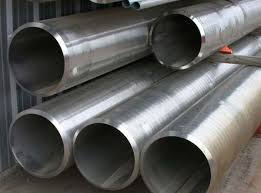
Welded 410S Stainless Steel tubing handles 300 °C hydrocarbon on the shell side and 200 °C cooling water inside; low carbon prevents weld-decay during field repairs, extending service life to 15 years.
Petroleum Refining Equipment
Fractionating column trays, down-comers and reheater shells operate at 400 °C with sulfur compounds; 410S’s sulfidation resistance equals 410 while weldability eliminates costly post-weld heat treatment.
Furnace Parts & Conveyor Belts
Carburising furnace belts use 3 mm 410S plate at 650 °C; low expansion prevents warping, and welded joints remain ductile after 1 000 thermal cycles.
Automotive Exhaust Components
Manifold and turbo-down-pipe stampings survive 700 °C exhaust gas; 410S Stainless Steel’s thermal-fatigue life is triple that of 409 while costing 20 % less than 321.
Power Plant Boiler Baffles
Gas-turbine HRSG baffles at 550 °C tolerate sulfur and condensate; magnetic property allows induction welding, speeding fabrication 30 % versus austenitic grades.
Welded Piping Systems
Low-carbon 410S pipe transports hot neutral brines; weld HAZ remains below 22 HRC, meeting NACE MR0175 for sour service without post-weld quench.
Architectural Structural Elements
Annealed 410S angles support canopies in coastal-industrial zones; nickel-free chemistry avoids price volatility while providing 25-year corrosion life indoors.
Comparison with Other Grades – 410S vs 410, 304, 430, 409, 321
| Grade | Carbon % | Weldability | Corrosion Rating | Max Service Temp °C | Relative Cost | Typical Uses |
|---|---|---|---|---|---|---|
| 410 | 0.15 | Fair | Medium | 650 | Low | Hardware, blades |
| 304 | 0.08 | Excellent | High | 870 | Medium | Food tanks |
| 430 | 0.12 | Good | Medium | 815 | Low | Appliances |
| 409 | 0.08 | Excellent | Medium | 815 | Low | Exhaust |
| 321 | 0.08 | Excellent | High | 870 | High | Exhaust, aircraft |
| 410S | 0.08 | Excellent | Medium+ | 650 | Low | Welded structures |
Pros: 410S Stainless Steel provides the highest weldability and thermal-fatigue resistance among low-cost stainless grades up to 650 °C.
Cons: Not suitable for aqueous chloride or mirror-finish applications; for such cases select 321 or 316L.
Manufacturing Process & Quality Assurance
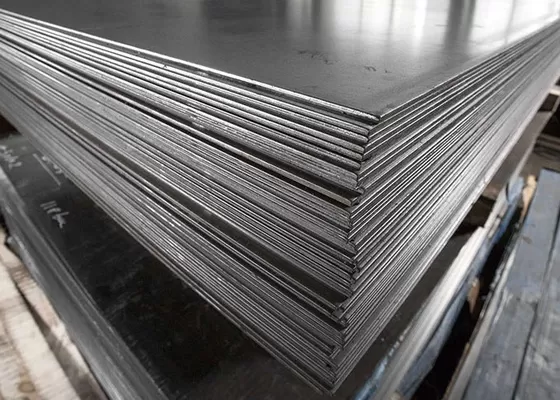
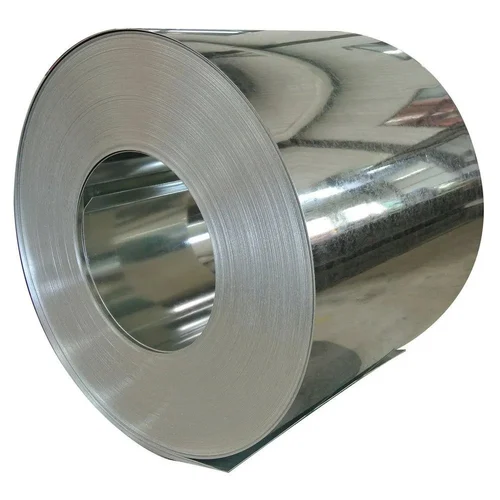
We melt 410S Stainless Steel in an electric-arc furnace, argon-oxygen decarburise to ≤0.08 % C and adjust chromium to 12 %, then continuous-cast into 200 mm slabs. Hot rolling to plate or strip is followed by full annealing at 815–900 °C in 100 % hydrogen to dissolve any residual martensite and optimise ductility. Finishes include No. 1 hot-rolled plate, 2B cold-rolled sheet, pickled matte and polished Ra ≤ 0.4 µm for architectural panels. Every heat is certified to ASTM A240/A268/A479, ISO 9001 and optional EN 10204 3.2; tests include ICP chemistry, weldability bend test, elevated-temperature tensile at 600 °C, and ASTM A262 Practice A intergranular corrosion. Third-party inspection certificates and NORSOK M-650 compliance are available for oil & gas projects.
Maintenance & Care Tips
Clean 410S Stainless Steel with warm water and a mild, chloride-free detergent; rinse and dry to prevent water spots. For high-temp components, annual inspection for oxide spallation is recommended—light brushing restores surface emissivity. Avoid hydrochloric or ferric-chloride cleaners that can initiate pitting. Store plate indoors, vertically separated by plastic, to prevent carbon-steel contact and subsequent rust staining.
Frequently Asked Questions
Q: Why choose 410S over standard 410?
A: Low carbon in 410S Stainless Steel eliminates hard martensite in welds, removing pre-heat and post-weld anneal while maintaining 650 °C oxidation resistance.
Q: Can 410S Stainless Steel be welded easily?
A: Yes—use 410S, 309L or 308L filler, no pre-heat, and no post-weld heat treatment; welded joints retain ductility and corrosion resistance.
Q: What is the maximum operating temperature for 410S Stainless Steel?
A: 650 °C for continuous oxidation resistance; above this select 321, 309 or 310 for long-life service.
Ready to weld without worry and still resist 650 °C heat at a nickel-free price? Contact us today for custom quotes on 410S Stainless Steel sheet, plate or tube—mill-direct pricing, global delivery and full metallurgical support included.